Advisory · Field Notes
Working the Floor at Indonesia Critical Minerals 2026
June 2026 · Jakarta
I flew to Jakarta with the founder of Baniql for Indonesia Critical Minerals 2026 — the Shanghai Metals Market conference under the banner “Shaping the Future of Global Critical Minerals.” Two days on a conference floor can produce a stack of business cards you never look at again, or a handful of relationships that shape a company's next chapter. The difference is method.
The method
This one I learned from one of my mentors, Shanto — the golden boy. It fits on a napkin:
- Scope the room before you stop and talk to people. Walk the whole floor once. No conversations yet — just a map.
- Find the interesting booths and learn everything you can.
- When something's interesting, keep researching with AI. Between sessions, go deep: who owns the company, what they actually ship, what their customers say, what the second-order play is. You return to the booth knowing more than the person who handed you the brochure expects.
- Prioritize the conversations that matter — the floor is a queue and you control your position in it.
- Debrief after each one. Thirty seconds of notes beats an evening of trying to remember who said what.
A masterclass in nickel
The best hour of the conference was the Nickel Institute's chairwoman walking the entire global nickel market, mine to end use, in one slide:
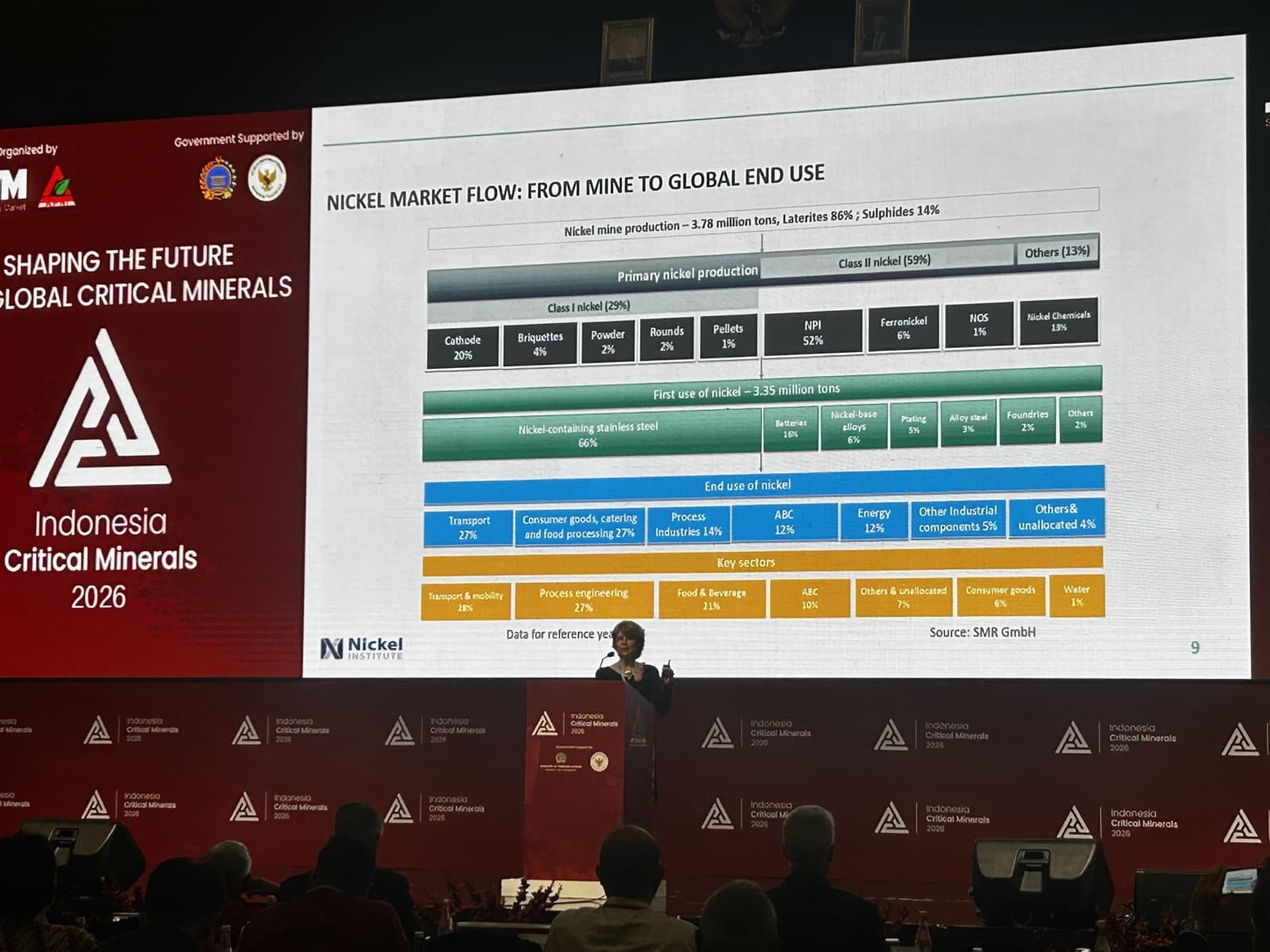
The numbers that stuck (source: SMR GmbH, via the Nickel Institute):
- 3.78 million tons of nickel mined — 86% from laterites, 14% from sulphides.
- Only 29% is Class I (cathode, briquettes, powder); 59% is Class II — and NPI alone is 52% of primary production. That's the Indonesia story in a single number.
- Everyone in the room was there to talk batteries — but stainless steel still takes 66% of first use; batteries take 16%. Nickel is a stainless story with a battery subplot, not the other way around. Yet.
- End use spreads wider than you'd guess: transport 27%, consumer goods and food processing 27%, process industries 14%, energy 12%.
That slide reframed half the booth conversations that followed — which is exactly the point of the method. Learn the map, then walk it.
Why I was there
Baniql is building sustainable nickel and cobalt extraction for lithium-ion batteries — a cleaner, more cost-effective alternative to traditional methods. What started as an AI workshop with their team became a formal advisory role: factory floor in Indonesia one week, conference floor in Jakarta the next. Advisory means showing up, not just advising.