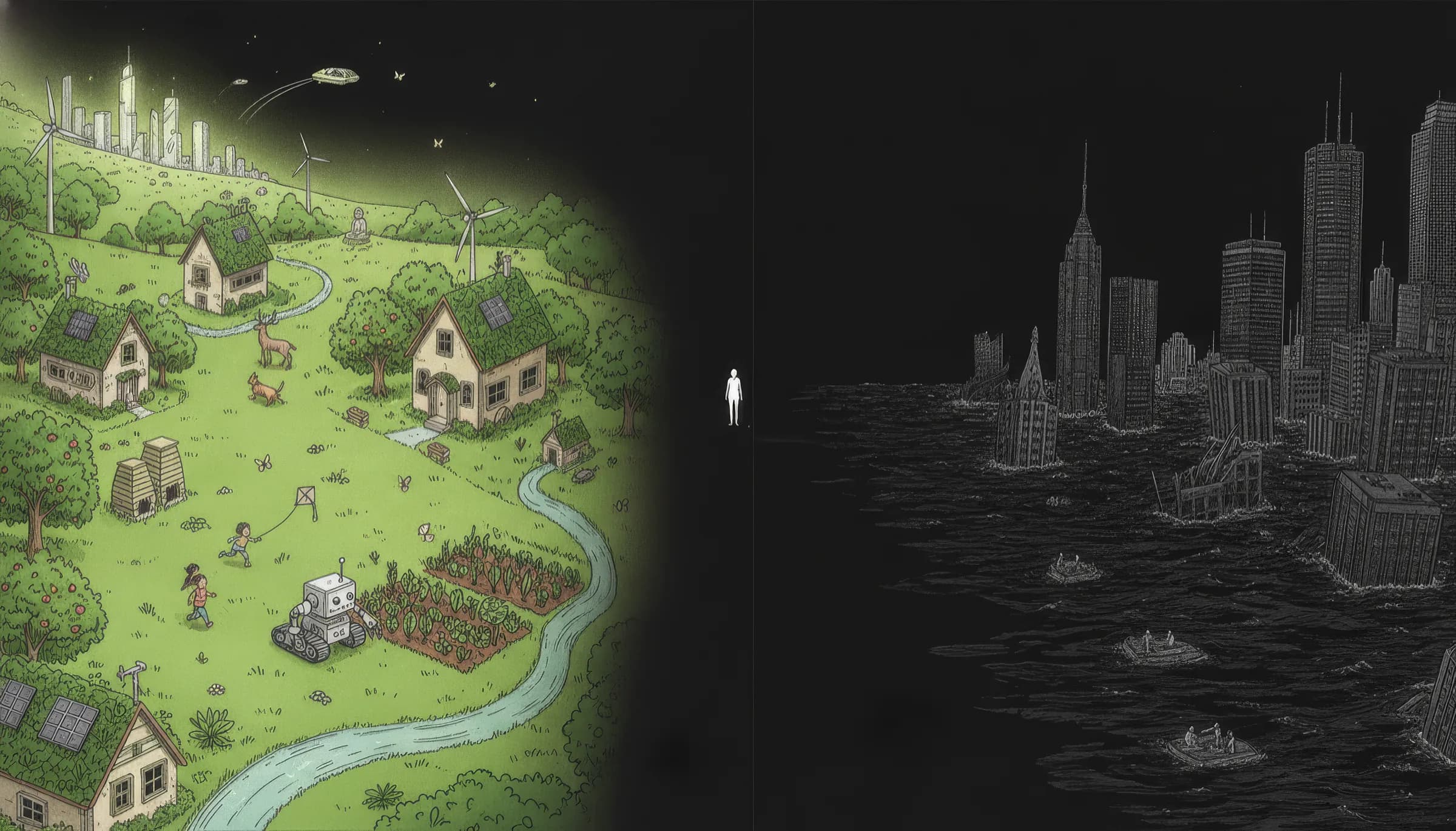
Essays · June 2026 · 8 min read
The Techno-Utopia Will Be Built by Profiteers
Or — why I stopped waiting for the solarpunk future and started funding it.
The doomers think AI ends the world. I think it might save it — by helping us profit our way out of the climate crisis. That's why I'm investing in energy companies and teaching them AI.
The 20%
The doomers have been warning us about AI for years.
I usually acknowledge them with a wink — sure, it could happen, but how likely is it, and what could we even do to stop it?
Nothing, really — you can't stop this. The models are open source now, out in the wild and copied onto countless machines, as unstoppable as Bitcoin. Governments can shut a frontier lab down and it won't change a thing.
Then, a couple of days ago, Scott Alexander's widely-read blog dropped two forecasts.
A 20% chance of apocalypse by 2100 — and, happily, a 20–40% chance of a techno-utopia.
His forecast leaves out the same thing the doomers always do: there's already a slow-motion apocalypse running. Climate change.
The world has already warmed one and a half degrees Celsius. In some places, wet-bulb temperatures have lately pushed past what a human body can survive — for hours at a time, killing thousands.
So whether or not AI ever turns on us, the climate already has.
Scott's odds for 2100
- 20–40%Techno-utopia
- 40–60%Somewhere in between
- 20%AI apocalypse
Used well, AI is one of the few tools powerful enough to help us change that. The other is profit. Together, they're enough to build a livable planet.
Get off fossil fuels and we could stop climate change — even reverse it. The obstacles are huge, but the tools are finally here.
With just solar — already the cheapest power humanity has ever built — we could generate all the energy the world needs. Better batteries hold it through the night — enough storage to bank the sun and the wind and the heat of the earth, all the energy already moving around us.
Or we can point the most powerful tools humans have ever built at what we usually point new tech at: video games and porn. (We mostly point them at video games and porn.)
Same power, just pointed at something sillier. Betting my career on aiming it at what matters instead is less naive than it sounds. But I didn't always believe that. Here's what changed my mind.
We can change the future
We'll never know for certain whether free will is real — nobody can. But it's the one question where believing changes the answer. If you act like you can steer, sometimes you can. If you act like you can't, you never will.
The Serenity Prayer
God, grant methe serenity to accept the things I can't change,the strength to change the things I can,and the wisdom to know the difference.
For years I said it reaching for the serenity, to be at peace with a messed up world. But a couple of months ago, on the flight home from my first trip to Dhaka, I reframed it around the second line instead: the strength and courage to change what I can.
A few days later in Bangkok, I couldn't sleep so I went for a walk at sunrise. A few hours later I came upon a ferryman who paddled me across a river — bare feet braced in a purple hull, one wooden oar, floating houses and a gold shrine sliding past. He read the current and pulled, and the whole boat came around.
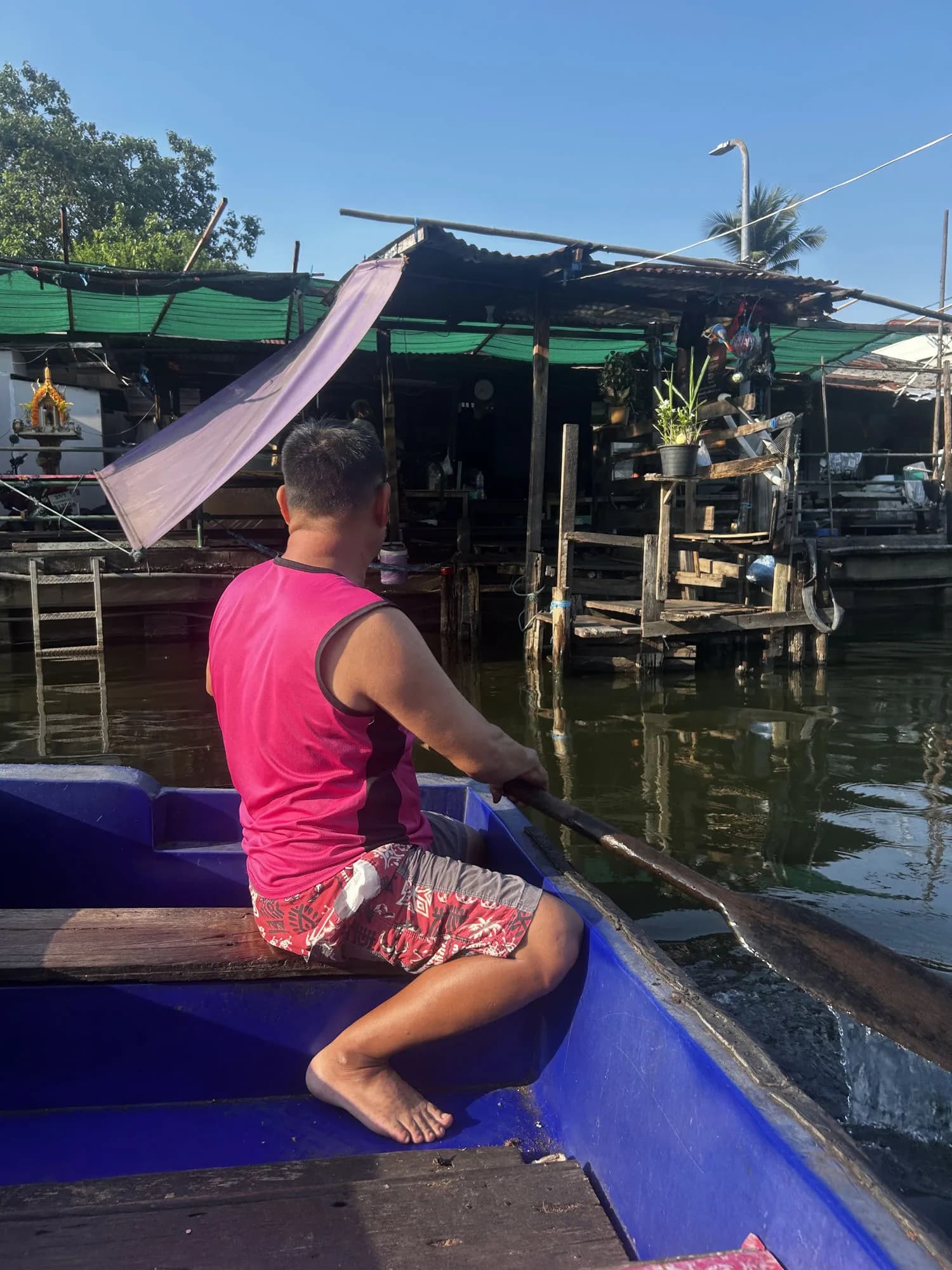
That was the new line, sitting in front of me in a pink tank top: watch the current, and pull.
And things started to move. The boatman felt like the first thing to show up — then a business partner did, and I got into VC Lab. The current had been running my way the whole time. I just had to pull.
My partner and I flew to the Beijing auto show, and I watched a whole industry tilt electric in a single hall. I'd moved to China at nineteen and spent my twenties there; twenty-five years on, it was like seeing my baby all grown up. And I said to myself: we have to do this for the rest of the developing world.
I still don't have the third line — but now I've framed it as the wisdom to know what I can't change.
The curve is real
The thing is, I don't have to bend the future alone. There's already a movement, decades in the making, and I'm one more person joining it. Rather than sit serene in a world this far off course, I can throw my weight behind what's already moving — and maybe together we fix it in time.
A solar panel cost about $128 a watt in 1975; the published price is 26¢ a watt now — a 99.8% fall that has held for fifty straight years — and the quote I was offered last week was 11.7¢. Battery packs are down 91% since 2010.
That's what happens when you manufacture at scale and keep compounding new science into it — and it's happening everywhere. One curve goes down every year a factory runs. Fossil fuel — priced by what's left in the ground — never will:
Solar PV module
The future isn't waiting to be discovered — we're building it right now, most of us as if money were the only thing that mattered.
But money is exactly the reason to bet on the techno-utopia. New energy now beats the old way on total cost of ownership in almost every use, and with a little creative financing it can be deployed today, not in some far-off year.
And profit is the only thing that scales. Goodwill and grants and volunteers all run out eventually. But a margin keeps compounding on its own — it pulls in money whether or not anyone cares about the planet. That's the engine. We don't need everyone to suddenly get kinder — we just need the right thing to pay better than the wrong thing. And now, finally, it does.
Those savings are big enough to reshape the world economy. Energy is about 9% of global GDP — on the order of $9 trillion a year — and clean is quietly undercutting all of it.
It's the biggest opportunity of this century, as big as AI or bigger. And the two shifts — getting smart and getting clean — won't stay in their own lanes. They'll fold into just about everything at once.
Sure, some people will take the fast, dirty money anyway. That future gets built with or without me. I've only got one shot, and I'm spending it on the other one — and yes, I want my share; I've got a family to feed. The techno-utopia is built by profiteers, and I intend to be one of them. But choosing this profit over the easy, dirty kind takes more than a spreadsheet.
A 2,500-year-old wager
It needs an answer to one question: what if I'm wrong? The best one I know is 2,500 years old.
In the Kalama Sutta, a town full of people tell the Buddha they've been visited by too many fake gurus, each glorifying his own ideas and tearing down the rest, and they no longer know whom to believe.
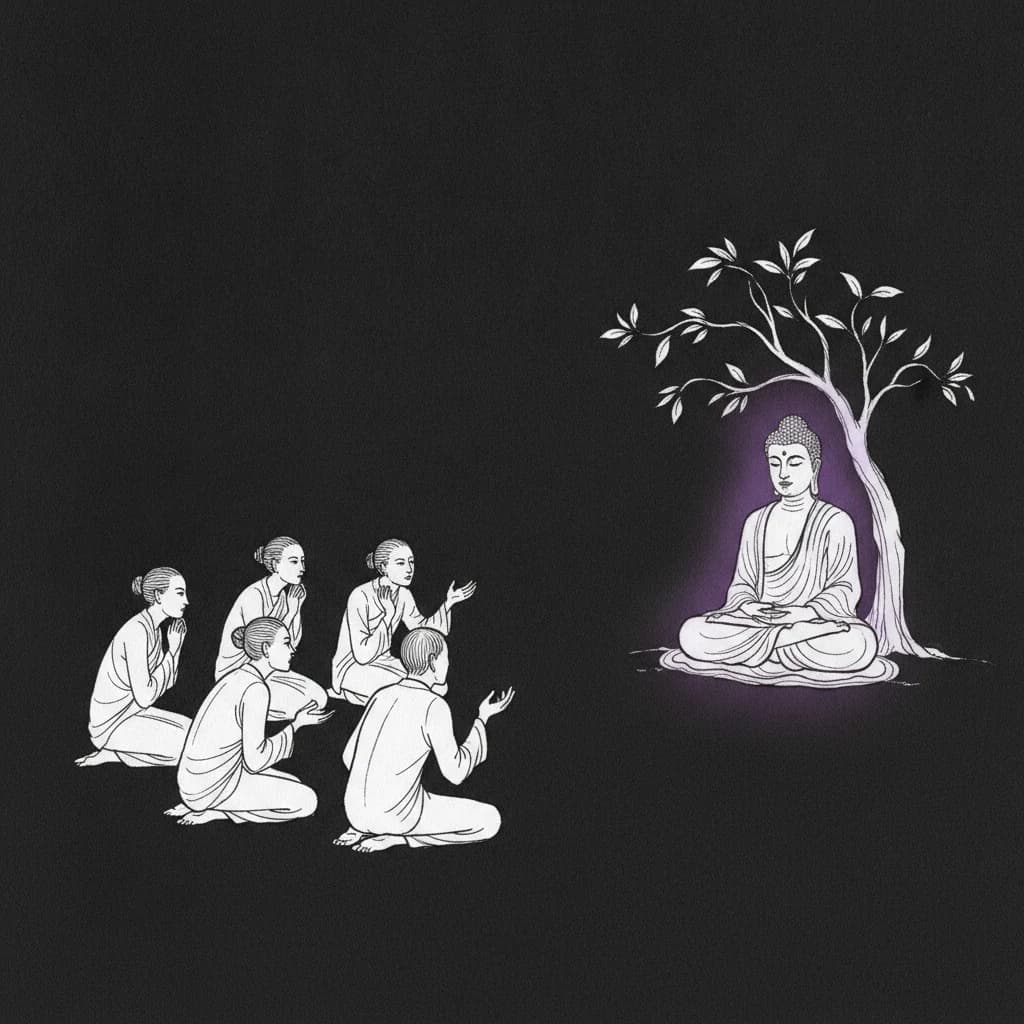
His answer is the most modern thing in ancient literature: don't believe something because it's repeated, because it's in a respected book, or because the person saying it seems impressive — even if that teacher is me. Test it against what you can see for yourself: does acting on it lead toward harm, or away from it?
Then he closes with a wager. A person who lives well holds a winning ticket in every branch: if there's a next life, they're in good standing for it; if there isn't, they still lived in peace here. Either way, they come out fine.
If that rings a bell, it's Pascal's wager, about 2,100 years early — but better. Pascal has you wager on belief. The Buddha has you wager on nothing at all — you already know good from bad, so invest your one life in good, and you come out ahead no matter which way the world breaks.
You don't have to talk yourself into anything about the afterlife, or about 2100. You just act, and you've already collected the one prize you keep for sure: a life well lived, right now.
Run my bet through the same machine. In all three branches I'll come out fine — and in the two with a world left to build in, I'll do well too:
- The techno-utopia will arrive: the people I trained and backed will help build it, and my investments will do well.
- The world will only muddle through: a planet scrambling to adapt will be desperate for the clean energy and tools the founders I back will build.
- The worst will happen anyway: there'll be no fortune to be made in a wrecked world, and I never thought there would be — but I'll have spent my shot fighting to fix it, and that will be the prize either way.
There's no version of the future where I regret the work — a bet you can't lose. That's exactly the kind of belief the Kalama test clears you to act on: the part that matters is one you can check yourself. Does the work lead toward harm, or away from it?

And don't take "clean is the better business" on faith either — run the Kalama test on it. Pick any market where clean and dirty compete head to head, and look at what the numbers already say:
The economics, quickly
Three markets, one verdict: clean is the better business
Gas car
~7¢/km
fuel alone — plus roughly double the maintenance
EV
~2¢/km
and a fraction of the moving parts to service
Coal
6–10¢/kWhlifetime
most of it fuel you keep buying for 30 years
Solar
3–5¢/kWhlifetime
pay once to build — the fuel is free forever
Old-way nickel
~33% margin
$7k inputs + $3k fuel against a $15k ton — about $5k left over
Clean nickel
~53% margin
same $7k inputs, no fuel — the $3k fuel bill drops straight to margin (~$8k a ton)
See the process economics →The odds aren't fixed
Here's the part the doom forecasts miss: the odds of a techno-utopia by 2100 aren't fixed. They're a guess about what billions of people will do — and a guess like that can come true just because enough people believe it. The odds rise or fall depending on how many treat that future as reachable and act like it.
The apocalypse doesn't need anyone's help — the oil and gas incumbents are building it just fine. The utopia is the one that needs us, and it's built by profiteers too: the ones who finally found the money in doing it right, and undercut them until they're out of business.
A startup never dies until its founders give up. The solarpunk future works the same way. Nobody can kill it from outside — it only dies if we walk away. That's why faith, the kind that stays loyal to a path even when you can't see the end, is the key to this whole bet: refusing to quit is the one move that keeps it alive.
Still — I'll never know if I moved the odds at all. One life against a planet barely registers: too small to measure, never quite zero. So I act as if my choice counts, because I can't prove it doesn't — and because the one future it's certain to change is the one I'll be standing in.
So that's why
This is why AimHuge trains the people it trains. When I teach a team to use AI, I'm handing them superpowers — and I'd rather give them to people building things I want more of in the world.
"Alex's energy and curiosity are infinite and contagious! Under his mentorship, our non-coding team completed months of work in hours and started coding."
It's also why I'm founding AimHuge Holdings, to back founders building clean energy in the markets that need it most.* It's an energy play — clean is simply where the returns are now.
* At AimHuge Holdings, clean energy is anything that generates, stores, or saves it — from the sun to the seabed: solar, green nickel, batteries, EV fleets, even sustainable-farming inputs and hempcrete bricks.
And it's why we're giving away our 171 (and counting) best startup ideas in the AimHuge Idea Bank — each one drawn from a business running somewhere in the world. Proven in the field, and a movement you can join.
All three are the same bet: aim this power where doing good finally pays, then hand it to whoever shows up for the money. You need profit to scale — each win funds a bigger one, and that one funds a bigger one again — and that's how the profiteers build the techno-utopia for you.
And every "good" team that learns to use AI well puts this power in the hands of real people doing real good — instead of leaving it to the incumbents with the deepest pockets and the least reason to change.
Scott Alexander says you can't know which future we'll get until we get there. But we're already here — and all three of his branches are already true, somewhere, right now. The future is just unevenly distributed: a sliver of utopia here, the apocalypse already arrived there, the long muddle everywhere between.
We're not waiting to find out which world we got — we're choosing which one to feed. So that's my answer: keep building the techno-utopia, and hand it to everyone who'll show up to get rich on it.
So — if any of this is yours, this is where you step in.
If you're building something good and want your team to be dangerous with AI, that's what the workshops and advisory are for.
If you're already building in clean energy, apply for funding at AimHuge Holdings.
And if you're an entrepreneur itching to jump — you know you want out, you just don't know which way to leap — browse the AimHuge Idea Bank, pick one, and start a business that makes money and does good. The solarpunk future is built by profiteers — the kind who get rich doing the right thing. Consider this the recruiting pitch.
P.S. The first draft of this essay was written with the help of Anthropic's Fable 5 — pulled by U.S. government order days after launch, judged too dangerous to leave running. Shut down overnight — no undo. The doom and the promise are the same engine.