Author
Plain Dharma
The Buddha taught farmers, merchants, and kings in the everyday speech of the road. When two monks asked him to recast his words in formal verse, he said no: let people learn them in their own language. So why do most English translations read like legal documents?
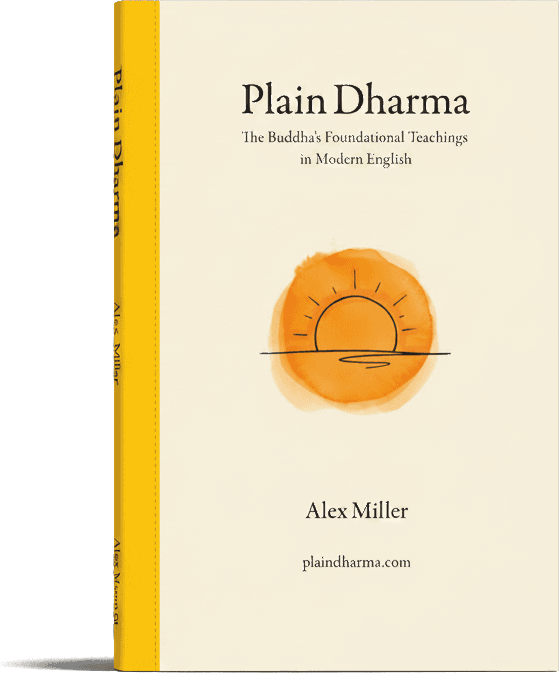
Plain Dharma puts six of his foundational teachings back into plain modern English: short enough to read in an afternoon, faithful enough to take seriously.
Public domain (CC0). Free to read, copy, print, and share.

About Alex Miller
I grew up in New York and studied East Asian Studies in college, where I first tried to read the suttas, cramming them the night before exams. I spent the next eleven years in China, learned to (barely) read classical Chinese, and have spent 25 years building software companies across Asia. I live in Chiang Mai now, surrounded by temples.
I kept going back to the Buddha's words: in college, in Bali, in San Francisco, in Chiang Mai. Every time, the stiff language turned me away. “Thus have I heard” made it sound like a god being worshipped, not a teacher being read. The dharma reached me anyway, through D.T. Suzuki, Kerouac, Thich Nhat Hanh, temple murals, and the occasional deep breath. The scripture never did.
So one night, awake at 3 a.m., I asked a plain question: what did he actually say? By sunrise I had read all six teachings in one sitting and understood them for the first time. Plain Dharma is that reading, worked over line by line against the Pali until it holds up.
The suttas began as an oral tradition and were only later written down by monks, so I took the liberty of translating them back toward the spoken word.
By day I train teams to build with AI and invest through AimHuge Holdings. More on my background.
What's inside
Six teachings, about 45 minutes to read. Every later teaching and every Buddhist tradition builds on these. If you've read them, you've read what was there at the start.
01
The Buddha's First Talk
The four noble truths, taught for the first time.
Dhammacakkappavattana Sutta
02
The Buddha's Second Talk
Why your mind and body are not really you.
Anattalakkhana Sutta
03
The Fire Sermon
We burn with wanting, anger, confusion. Let go.
Adittapariyaya Sutta
04
On Loving-Kindness
Goodwill for all beings, almost a poem.
Metta Sutta
05
The Foundations of Mindfulness
A guided meditation by the Buddha himself.
Satipatthana Sutta
06
How to Decide What to Believe
The Buddha's case for thinking for yourself.
Kalama Sutta
Every edition
Everything flows from one source text. Amazon sets its own prices; every other edition is free.
How it was made
I don't read Pali. The English was translated from the original Pali by Claude Opus, Anthropic's AI, and then I edited it line by line, checking each passage against the canonical text on SuttaCentral. The Chinese edition was edited by Yan Zhang. The cover is by me and Ellen Shapiro.
The drafts came fast. The editing was slow. Every term got the same treatment: fetch the Pali, lay out its range of meanings, and choose from the real range rather than whatever the machine agreed to. The three poisons, moha, rāga, dosa, are usually Englished as delusion, greed, and hatred. I kept asking until I got to confusion, wanting, and anger: plain words everyone has felt. Most of the finishing happened on a flight from Chiang Mai to Surabaya, pen on a printed proof, reading along with the audiobook.
This is not a substitute for a scholarly translation. If a teaching here moves you, read the same passage by Bhikkhu Bodhi or Thanissaro Bhikkhu next. Plain Dharma is a starting point.